Little Hands, Big Skills: Teaching Life Skills to Preschoolers
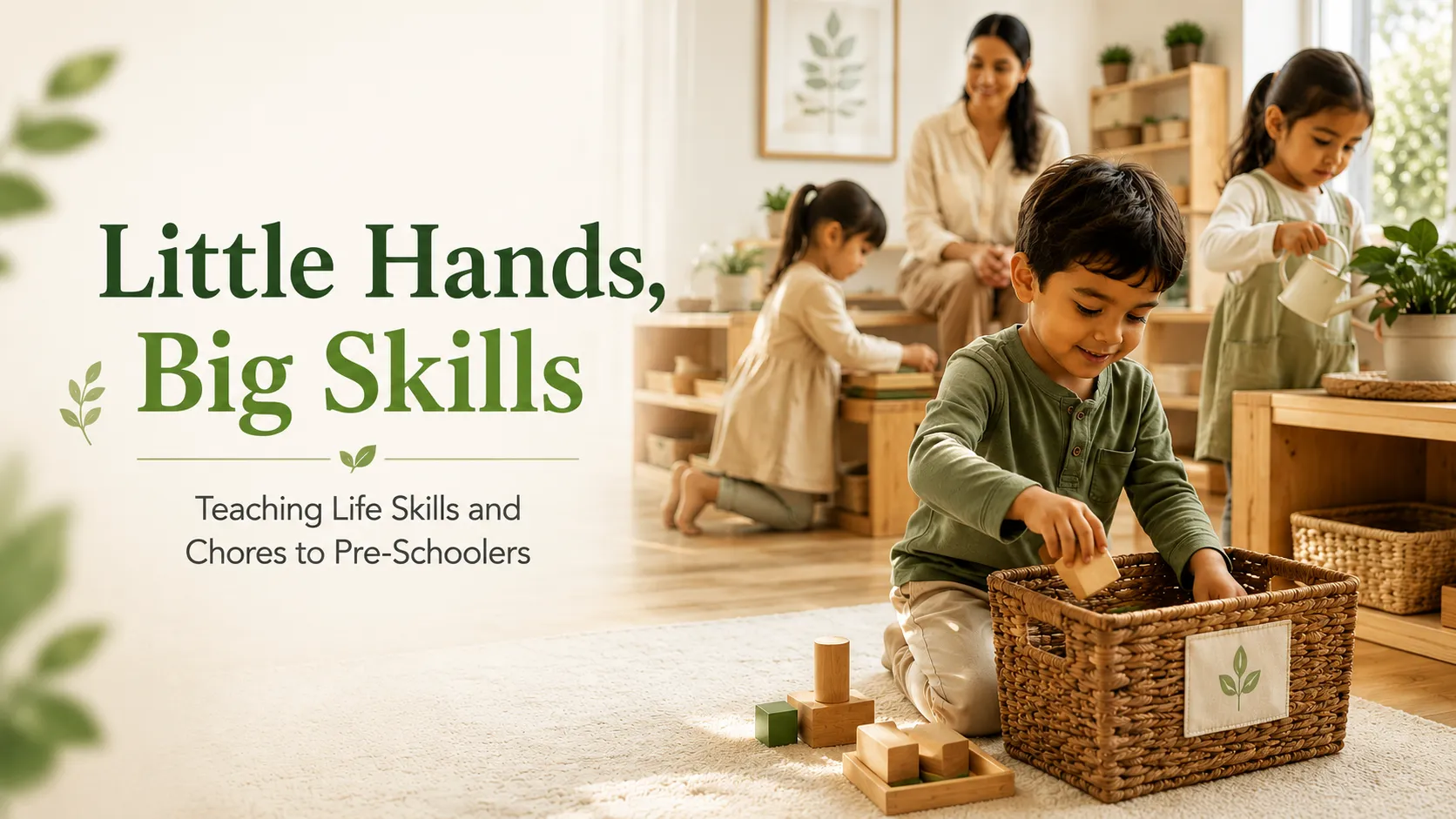
Teaching life skills in early childhood helps children develop independence, confidence, responsibility, and resilience. Simple everyday tasks such as tidying up,dressing independently, helping with classroom routines, and completing age-appropriate chores build executive functioning, social skills, emotionalregulation, and school readiness.
Picture this. It's aTuesday morning, and you're already ten minutes behind. Your three-year-old spots the cereal box and announces, with complete certainty: "I can doit myself." You have two choices. You take the box, pour the bowl, and get out of the door on time. Or you pause — and hand it over.
That pause? It might be one of the most important things you do all day.
Research in early childhood education consistently shows that children learn best through meaningful, hands-on experiences. Everyday responsibilities become valuable learning opportunities that support both personal development and academic success.
Early childhood is when habits, identity, and self-belief begin to take root quietly. Pre-schoolers are natural imitators. They watch everything we do and ache to join in. Life skills education isn't about turning small children into little helpers. It's about honouring that instinct — and letting it grow into something lasting.
At Ivy Grove, this is built into the very fabric of the day. Each morning, children place their own belongings into labelled cubbies. It takes longer than it would if a grown-up did it. That's the point.
When your child reaches for independence, do you support that moment — or quietly redirect it? This decision will shape their confidence level at an early stage.
Encouraging independence during the preschool years helps children build self-esteem, problem-solving skills, perseverance, and a positive attitude towards learning.
So, What Counts as a Life Skill at This Age?
Life skills are the everyday competencies that allow children to care forthemselves, connect with others, manage their feelings, and contribute to their community.
Life skills in early childhood education focus on helping children become capable, confident, and responsible individuals through everyday routines and practical experiences.
At the pre-school stage, they live across four domains:
· Self-care — dressing, hygiene, and managing their own needs
· Social skills — sharing, turn-taking, and cooperation
· Emotional skills — naming and expressing feelings appropriately
· Practical skills — tidying, organising, and caring for shared spaces
These everyday experiences strengthen independence while supporting cognitive development, emotional,physical, and social development.
Life skills activities for pre-schoolers don't need to be complicated. Putting toys in a labelled bin.Watering the classroom plant. Placing napkins at snack time. The standard isn't neatness — it's showing up and trying.
At Ivy Grove, these aren't extras layered on top of learning. Clean-up transitions, snack preparation roles, plant-care rotations — they're woven into the life skills curriculum because they build the executive functioning skills that sit beneath academic readiness. Children aren't just tidying up. They're practising planning, sequencing, and self-regulation — every single day.
These practical experiences also develop attention, memory, organisation, decision-making, and the confidence to complete tasks independently.
Why Life Skills Matters More Than We Think
Here's something worth knowing. The Harvard University Centre on the Developing Child found that executive function skills — working memory, flexible thinking, self-control —are significantly strengthened through consistent, hands-on responsibility in early childhood. Not through flashcards. Not through worksheets. Through doing real things, repeatedly, in a supportive environment.
Executive functioning skills developed through practical responsibilities form the foundation for learning, emotional regulation, communication, and long-term academic achievement.
Life skills development happens in these ordinary moments. When a child waters the plant, they're building fine motor skills. When they sort the materials, they're thinking logically. When they help set the table, they're learning that their presencein a community carries weight.
That's why at IvyGrove, educators don't simply say "tidy up." They ask: "Whatcomes next? What does this space need?" A tidy classroom here provides aclean and inspiring space to think with clarity.
Children who participate in everyday routines also develop resilience, persistence,responsibility, and confidence in their own abilities.
The Doubts Are Real — Let's Name Them
Most parents don't hol dback from involving their children because they don't care. They hold back because they're busy, because they love their children, and because it genuinely is faster to just do it themselves. These thoughts are worth naming honestly:
"They're too young." Children as young as two and a half actively want to help. They are more capable than we typically give them credit for.
"It's faster if Ido it." It is. Right now. But every time we step in, we quietly communicate: this is too hard for you. Efficiency today can quietly cost capability tomorrow.
"Chores take away from play." Not when they're woven into the rhythm of the day. At Ivy Grove, we slow transitions deliberately — because what looks like inefficiency is learning life skills inmotion.
"They won't do it properly." They won't. That's the whole point of practice.
Many parents naturally want to help, yet allowing children to complete age-appropriate tasks independently often provides greater long-term benefits than completing the task for them.
Are you prioritising efficiency over development? Have you started to equate neatness with success? These are a few thought sworth pondering over.
Progress matters farmore than perfection. Every attempt helps children develop confidence,competence, and resilience.
The Role of Parents — And Why Modelling Is Everything
Children are watching. Not just in the classroom — at home, at the dinner table, in the car, in the kitchen. They absorb how we move through ordinary tasks, how we respond tomess, and whether we follow through on small things.
Parents and educators play an essential role in modelling positive habits, responsibility, organisation, kindness, and perseverance. Children learn life skills not only through instruction but also by observing the adults around them.
Teaching life skills isn't a curriculum moment — it's a way ofliving. When adults approach tasks with calm and competence — organising without drama, completing what they start — children internalise the message that contribution is simply what people do. It's normal. It's expected. It matters.
At Ivy Grove, teachers scaffold carefully. A napkin is folded once, demonstrated slowly — then children are invited to try. There's no hovering, no stepping in unless genuinely needed. That restraint is an act of deep trust.
And when the same expectation of contribution lives at home and at school, something important happens: children feel the coherence of a world that makes sense. That consistency is not a small thing. It is developmentally significant.
Consistent expectations between home and preschool create a secure learning environment where children feel confident taking on new responsibilities.
The Long View: Small Habits, Big Outcomes
Longitudinal research linked to Harvard University tells us that important life skills for students are rooted in habits formed long before formal schooling begins. Children who take on meaningful responsibilities early are more likely to grow into adults with astrong work ethic, accountability, and the ability to collaborate. The habits formed before age five don't simply fade — they compound, year by year, experience by experience.
Teaching life skills from an early age supports children's independence, school readiness, emotional wellbeing, and future success both inside and outside the classroom.
Life skills activities for students at the kindergarten stage — tidying, caring, contributing — lay the groundwork for everything that follows. Life skills activities for kindergarten children needn't be elaborate. They simply need to be consistent, purposeful, and held with warmth.
At the close of eachday at Ivy Grove, children gather in a reflection circle. One question isasked: "How did you help today?"
It's a small ritual. But over months and years, it teaches something profound — that their contribution was seen, that it mattered, and that helping is simply part of who they are.
These daily routines help children develop leadership, accountability, teamwork, and a growth mindset that continues well beyond the preschool years.
Raising Children Who Believe in Themselves
Life skills activities are not about productivity. They are not about tidy shelves or perfectly folded napkins.
Life skills education encourages children to become confident learners who approach challenges with curiosity, resilience, and a willingness to try.
They are about a child who grows up knowing they are capable. Knowing their efforts count. Knowing that in any room they walk into — home, school, or far beyond — they have something to offer.
At Ivy Grove, responsibility is intentional. It lives in the routines, the transitions, the quiet rhythms of an ordinary school day — because we believe the most important life skills are not taught in a single lesson. They are lived, repeated, and slowly owned. By little hands. Reaching out to do something real.
When children are trusted with meaningful responsibilities, they begin to see themselves as capable contributors, an important foundation for lifelong learning, confidence, and personal growth.
Frequently Asked Questions
Why are life skills important for preschoolers?
Life skills help preschool children develop independence, confidence, responsibility, communication, emotional regulation, and problem-solving abilities. These skills also support school readiness and lifelong learning.
What life skills should preschool children learn?
Age-appropriate life skills include:
- Dressing independently
- Washing hands
- Packing away toys
- Tidying shared spaces
- Helping set the table
- Caring for plants
- Sharing and taking turns
- Expressing emotions appropriately
- Following simple routines
How do chores benefit young children?
Simple chores teach responsibility, organisation, teamwork, perseverance, and executive functioning skills while helping children feel capable and valued within their family or classroom.
What are executive functioning skills?
Executive functioning includes working memory, self-control, planning, flexible thinking, attention, and organisation. These skills are essential for learning, behaviour, and future academic success.
How can parents encourage independence at home?
Parents can encourage independence by allowing children to complete age-appropriate tasks, offering guidance instead of taking over, praising effort, and creating consistent daily routines that build confidence.
Confused about preschool readiness?